CoO
Cobalt(II) oxide · Cobaltous oxide
Cobalt(II) oxide is a stable semiconducting transition metal oxide widely studied for its potential as a high-capacity conversion anode in electrochemical energy storage.
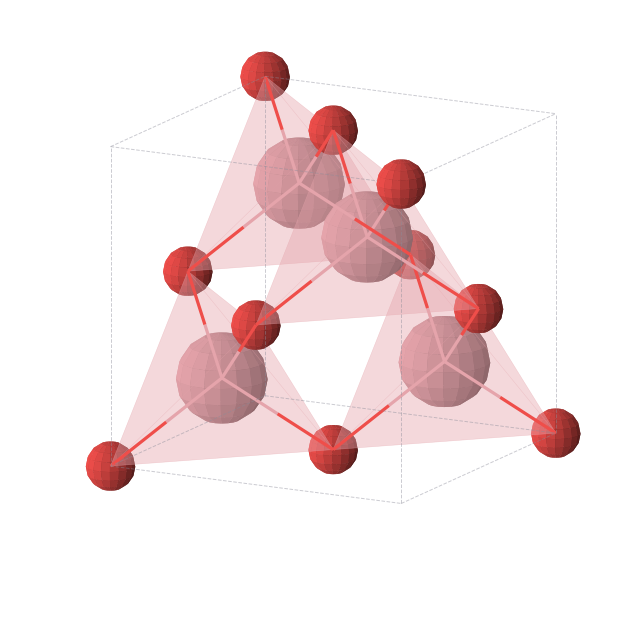
About Cobalt(II) oxide
Cobalt(II) oxide is a semiconducting transition metal oxide that sits on the thermodynamic convex hull, indicating high stability. As a member of the conversion oxide anode class, it is heavily researched for its ability to store energy through chemical transformation rather than simple intercalation.
This material is a subject of extensive structural investigation, with hundreds of reported configurations across major databases. Its electronic and structural characteristics make it a foundational candidate for studying the mechanisms of conversion-based energy storage systems.
Key Properties
Cross-validated computational properties for Cobalt(II) oxide, aggregated across 4 databases.
Band GapEnergy needed to move an electron from the valence band to the conduction band. Lower or zero values tend to behave more metallic; larger gaps are more insulating or semiconducting.
Energy Above HullThermodynamic distance from the most stable set of competing phases. 0 eV/atom is on the convex hull; small positive values may still be experimentally accessible.
StabilityA plain-language summary of the best reported energy-above-hull result. It reflects whether the lowest-energy structure is on, near, or far from the stability hull.
StructuresCount of reported calculated crystal structures for this formula, including alternate polymorphs, source databases, and observed space groups.
Cross-Source DFT Agreement
How well independent DFT databases agree on the thermodynamics of CoO. Tight agreement means computed properties can be trusted without re-running calculations.
Agreement ScoreA normalized confidence score summarizing how closely independent DFT databases agree. Higher scores mean tighter cross-source agreement.
Hull SpreadDifference between the highest and lowest energy-above-hull values reported by comparable sources. Smaller spread means less thermodynamic disagreement.
Sources ComparedNumber and names of computational sources with comparable entries for this formula.
Space Group ConsensusWhether independent sources predict the same crystal symmetry for the lowest-energy structure.
Synthesis Routes
Literature-extracted synthesis procedures targeting CoO.
Applications
Where Cobalt(II) oxide is used.
Patent Landscape
6 patents reference CoO or close compositional variants.
| Patent | Title | Assignee | Granted |
|---|---|---|---|
| 12420267 | g-C3N4@CoO/MgAl2O4 nanocomposite for hydrogen generation | — | — |
| 12358810 | Co3O4/CuO/MgO and (Cu0.97Co0.03)O/MgO/CoO Nanocomposites and method of pechini sol-gel fabricating | — | — |
| 11859294 | W18O49/CoO/NF self-supporting electrocatalytic material and preparation method thereof | — | — |
| 11879175 | W18O49/CoO/CoWO4/NF self-supporting electrocatalytic material and preparation method thereof | — | — |
| 4147670 | Nonohmic ZnO ceramics including Bi.sub.2 O.sub.3, CoO, MnO, Sb.sub.2 O.sub. 3 | — | — |
| 4205996 | CoO Free black spinel ceramic pigment containing NiO, Fe.sub.2 O.sub.3 and Cr.sub.2 O.sub.3 | — | — |
Frequently Asked Questions
Common questions about Cobalt(II) oxide, answered from cross-validated data.
What is CoO?
Cobalt(II) oxide is a stable semiconducting transition metal oxide widely studied for its potential as a high-capacity conversion anode in electrochemical energy storage.
What is CoO used for?
What is the band gap of CoO?
Is CoO a metal, semiconductor, or insulator?
Is CoO thermodynamically stable?
How many polymorphs of CoO are known?
How is CoO synthesized?
What elements does CoO contain?
Where does the data for CoO come from?
How It Compares
Within the conversion oxide anodes class.
Within the family of conversion oxide anodes, Cobalt(II) oxide is distinguished by its thermodynamic stability compared to more complex oxides like Co3O4 or CoO2. While materials like MnO2 or Fe2O3 are also widely studied for their capacity, Cobalt(II) oxide remains a primary benchmark for understanding the fundamental redox behavior of cobalt-based conversion systems.
Related Compounds
Other Conversion Oxide Anodes in the database.
Data sources & attribution
- latticegraph — Lattice Graph Materials Intelligence Platform
Analyze CoO in the Lattice Graph platform
Polymorph comparison, confidence scoring, supply-chain risk, and patent monitoring — across 53 integrated data sources.
Explore the Platform →