FeS2
pyrite · fool's gold
FeS2 is a stable, semiconducting iron sulfide mineral widely recognized for its distinctive metallic luster and potential in photovoltaic technologies.
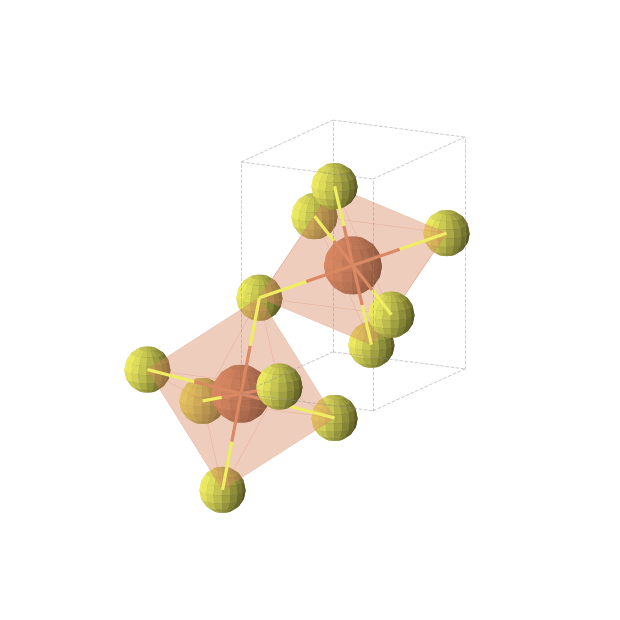
About pyrite
FeS2 is a naturally occurring iron sulfide that functions as a robust semiconductor. Its thermodynamic stability makes it a highly reliable subject for materials research, supported by a vast array of documented structural configurations that highlight its versatility in solid-state chemistry. Beyond its geological prevalence, this compound is significant for its potential in optoelectronic and energy storage applications. Its electronic character allows for efficient light absorption, positioning it as a compelling candidate for sustainable thin-film solar cell development and other next-generation electronic devices.
Key Properties
Cross-validated computational properties for pyrite, aggregated across 4 databases.
Band GapEnergy needed to move an electron from the valence band to the conduction band. Lower or zero values tend to behave more metallic; larger gaps are more insulating or semiconducting.
Energy Above HullThermodynamic distance from the most stable set of competing phases. 0 eV/atom is on the convex hull; small positive values may still be experimentally accessible.
StabilityA plain-language summary of the best reported energy-above-hull result. It reflects whether the lowest-energy structure is on, near, or far from the stability hull.
StructuresCount of reported calculated crystal structures for this formula, including alternate polymorphs, source databases, and observed space groups.
Cross-Source DFT Agreement
How well independent DFT databases agree on the thermodynamics of FeS2. Tight agreement means computed properties can be trusted without re-running calculations.
Agreement ScoreA normalized confidence score summarizing how closely independent DFT databases agree. Higher scores mean tighter cross-source agreement.
Hull SpreadDifference between the highest and lowest energy-above-hull values reported by comparable sources. Smaller spread means less thermodynamic disagreement.
Sources ComparedNumber and names of computational sources with comparable entries for this formula.
Space Group ConsensusWhether independent sources predict the same crystal symmetry for the lowest-energy structure.
Synthesis Routes
Literature-extracted synthesis procedures targeting FeS2.
Applications
Where pyrite is used.
Patent Landscape
7 patents reference FeS2 or close compositional variants.
| Patent | Title | Assignee | Granted |
|---|---|---|---|
| 8460403 | Method of storing iron disulfide (FeS2) particles | — | — |
| 9862617 | Method to synthesize colloidal iron pyrite (FeS2) nanocrystals and fabricate iron pyrite thin film solar cells | — | — |
| 5432030 | Li/FeS.sub.2 cell employing a solvent mixture of diox, DME and 3ME20X with a lithium-based solute | — | — |
| 4761487 | Method for improving voltage regulation of batteries, particularly Li/FeS.sub.2 thermal batteries | — | — |
| 7510808 | Low temperature Li/FeS2 battery | — | — |
| 4731307 | Methods for achieving the equilibrium number of phases in mixtures suitable for use in battery electrodes, e.g | — | — |
| 10457566 | Low-dimensional hyperthin FeS2 nanostructures for electrocatalysis | — | — |
Frequently Asked Questions
Common questions about pyrite, answered from cross-validated data.
What is FeS2?
FeS2 is a stable, semiconducting iron sulfide mineral widely recognized for its distinctive metallic luster and potential in photovoltaic technologies.
What is FeS2 used for?
What is the band gap of FeS2?
Is FeS2 a metal, semiconductor, or insulator?
Is FeS2 thermodynamically stable?
How many polymorphs of FeS2 are known?
How is FeS2 synthesized?
What elements does FeS2 contain?
Where does the data for FeS2 come from?
How It Compares
As a foundational iron-based sulfide, FeS2 serves as the primary benchmark for the study of transition metal dichalcogenides. It stands out in its class due to its exceptional thermodynamic stability and the extensive body of structural data available, which provides a critical reference point for evaluating the performance and synthesis of more complex or synthetic sulfide materials.
Data sources & attribution
- latticegraph — Lattice Graph Materials Intelligence Platform
Analyze FeS2 in the Lattice Graph platform
Polymorph comparison, confidence scoring, supply-chain risk, and patent monitoring — across 53 integrated data sources.
Explore the Platform →