TiC
Titanium carbide · TiC
Titanium carbide is a hard, metallic ceramic material prized for its exceptional thermal stability and wear resistance in high-stress industrial applications.
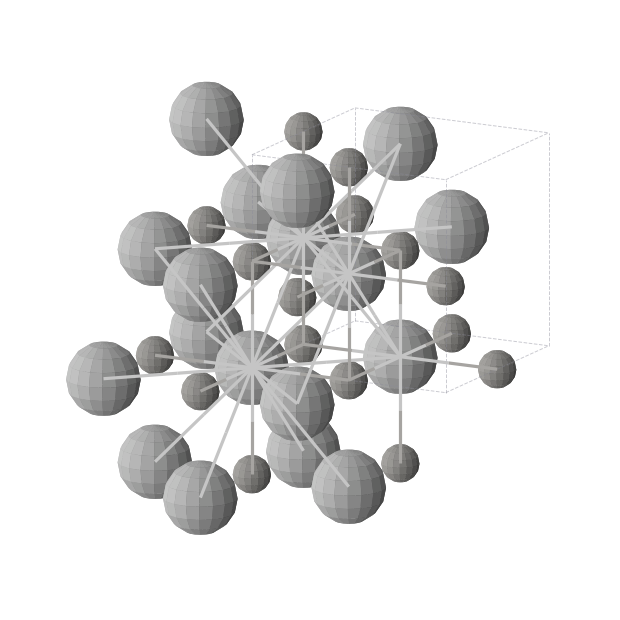
About Titanium carbide
Titanium carbide is a highly stable, metallic ceramic that serves as a cornerstone material in the field of ultra-high-temperature ceramics. Its robust structural integrity and electronic properties make it an essential component for demanding industrial environments where thermal resistance is paramount.
Because it sits firmly on the thermodynamic convex hull, this compound is exceptionally durable and resistant to degradation. It is frequently utilized in the production of cermets and specialized coatings that require superior wear resistance and high melting points.
Key Properties
Cross-validated computational properties for Titanium carbide, aggregated across 4 databases.
Band GapEnergy needed to move an electron from the valence band to the conduction band. Lower or zero values tend to behave more metallic; larger gaps are more insulating or semiconducting.
Energy Above HullThermodynamic distance from the most stable set of competing phases. 0 eV/atom is on the convex hull; small positive values may still be experimentally accessible.
StabilityA plain-language summary of the best reported energy-above-hull result. It reflects whether the lowest-energy structure is on, near, or far from the stability hull.
StructuresCount of reported calculated crystal structures for this formula, including alternate polymorphs, source databases, and observed space groups.
Synthesis Routes
Literature-extracted synthesis procedures targeting TiC.
Applications
Where Titanium carbide is used.
Patent Landscape
26 patents reference TiC or close compositional variants.
| Patent | Title | Assignee | Granted |
|---|---|---|---|
| 6001268 | Reactive ion etching of alumina/TiC substrates | — | — |
| 6027660 | Method of etching ceramics of alumina/TiC with high density plasma | — | — |
| 5439854 | TiC-base/SiC whisker composite ceramic cutting tools | — | — |
| 6126896 | Method of producing titanium carbide (TiC) based cermets through reaction milling process | — | — |
| 6293989 | Method of producing nanophase WC/TiC/Co composite powder | — | — |
| 5360772 | Ceramic material reinforced by the incorporation of TiC, TiCN and TiN whiskers and processes for production th | — | — |
| 4137076 | Electrical contact material of TiC, WC and silver | — | — |
| 4356272 | Sintered bodies Al.sub.2 O.sub.3 -TiC-TiO.sub.2 continuing yttrium (y) | — | — |
| 9138806 | In-situ combustion synthesis of titanium carbide (TiC) reinforced aluminum matrix composite | — | — |
| 7667277 | TiC as a thermally stable p-metal carbide on high k SiO2 gate stacks | — | — |
Frequently Asked Questions
Common questions about Titanium carbide, answered from cross-validated data.
What is TiC?
Titanium carbide is a hard, metallic ceramic material prized for its exceptional thermal stability and wear resistance in high-stress industrial applications.
What is TiC used for?
What is the band gap of TiC?
Is TiC a metal, semiconductor, or insulator?
Is TiC thermodynamically stable?
How many polymorphs of TiC are known?
How is TiC synthesized?
What elements does TiC contain?
Where does the data for TiC come from?
How It Compares
Within the ultra-high-temperature ceramics class.
Within the family of ultra-high-temperature ceramics, titanium carbide is one of the most extensively studied and utilized members. While compounds like HfC and ZrC share similar structural profiles and high-temperature performance, titanium carbide remains a preferred choice for commercial applications due to its favorable balance of density, hardness, and established manufacturing processes.
Related Compounds
Other Ultra-High-Temperature Ceramics in the database.
Data sources & attribution
- latticegraph — Lattice Graph Materials Intelligence Platform
Analyze TiC in the Lattice Graph platform
Polymorph comparison, confidence scoring, supply-chain risk, and patent monitoring — across 53 integrated data sources.
Explore the Platform →