TiO2
Titanium dioxide · Titania, Titanium(IV) oxide
Titanium dioxide is a versatile and stable inorganic compound used extensively as a white pigment, a photocatalyst, and a critical component in optical and electronic devices.
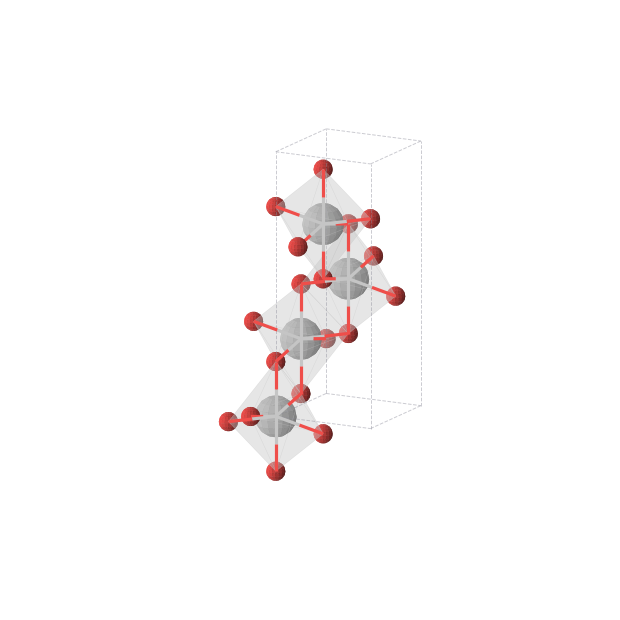
About Titanium dioxide
Titanium dioxide is a robust, thermodynamically stable inorganic compound that serves as a cornerstone material in modern industrial chemistry. Its wide-gap insulating nature and structural versatility allow it to function effectively in both high-performance optical applications and chemical processing environments.
With an extensive catalog of reported structures, this compound is one of the most thoroughly characterized materials in solid-state science. Its reliability and chemical inertness make it an essential component for technologies ranging from protective surface treatments to sophisticated environmental remediation systems.
Key Properties
Cross-validated computational properties for Titanium dioxide, aggregated across 4 databases.
Band GapEnergy needed to move an electron from the valence band to the conduction band. Lower or zero values tend to behave more metallic; larger gaps are more insulating or semiconducting.
Energy Above HullThermodynamic distance from the most stable set of competing phases. 0 eV/atom is on the convex hull; small positive values may still be experimentally accessible.
StabilityA plain-language summary of the best reported energy-above-hull result. It reflects whether the lowest-energy structure is on, near, or far from the stability hull.
StructuresCount of reported calculated crystal structures for this formula, including alternate polymorphs, source databases, and observed space groups.
Synthesis Routes
Literature-extracted synthesis procedures targeting TiO2.
Applications
Where Titanium dioxide is used.
Patent Landscape
139 patents reference TiO2 or close compositional variants.
| Patent | Title | Assignee | Granted |
|---|---|---|---|
| 7842131 | High opacity TiO2 pigment and production method | — | — |
| 11712681 | Near infrared photocatalyst based on TiO2-coated gold nanoparticles | — | — |
| 6517804 | TiO2 ultrafine powder, and process for preparing thereof | — | — |
| 9108862 | Method of making rutile titanium dioxide microspheres containing elongated TiO2-nanocrystallites | — | — |
| 9408791 | Oral care and oral hygiene products having photocatalytic activity comprising inorganic particles superficiall | — | — |
| 4356272 | Sintered bodies Al.sub.2 O.sub.3 -TiC-TiO.sub.2 continuing yttrium (y) | — | — |
| 9908100 | TiO2 material that is absorbent in the visible spectrum and method for producing same | — | — |
| 4462979 | Process for preparing soft TiO.sub.2 agglomerates | — | — |
| 5262142 | Composite oxide of formula R.sub.2 O.Al.sub.2 O.sub.3.TiO.sub.2.SiO.sub.2.H.sub.2 O, where R is an alkali meta | — | — |
| 5110772 | Fabrication of dense SI.sub.3 N.sub.4 ceramics using CaO-TiO.sub.2 SiO.sub. 2 | — | — |
Frequently Asked Questions
Common questions about Titanium dioxide, answered from cross-validated data.
What is TiO2?
Titanium dioxide is a versatile and stable inorganic compound used extensively as a white pigment, a photocatalyst, and a critical component in optical and electronic devices.
What is TiO2 used for?
What is the band gap of TiO2?
Is TiO2 a metal, semiconductor, or insulator?
Is TiO2 thermodynamically stable?
How many polymorphs of TiO2 are known?
How is TiO2 synthesized?
What elements does TiO2 contain?
Where does the data for TiO2 come from?
How It Compares
As a highly stable and structurally diverse material, titanium dioxide stands as a primary benchmark for performance in its class, serving as the standard against which many other oxide-based semiconductors and insulators are evaluated.
Data sources & attribution
- latticegraph — Lattice Graph Materials Intelligence Platform
Analyze TiO2 in the Lattice Graph platform
Polymorph comparison, confidence scoring, supply-chain risk, and patent monitoring — across 53 integrated data sources.
Explore the Platform →