WS2
Tungsten disulfide · Tungsten(IV) sulfide
Tungsten disulfide is a stable semiconducting transition-metal dichalcogenide widely utilized as a high-performance solid lubricant and a candidate for next-generation electronic devices.
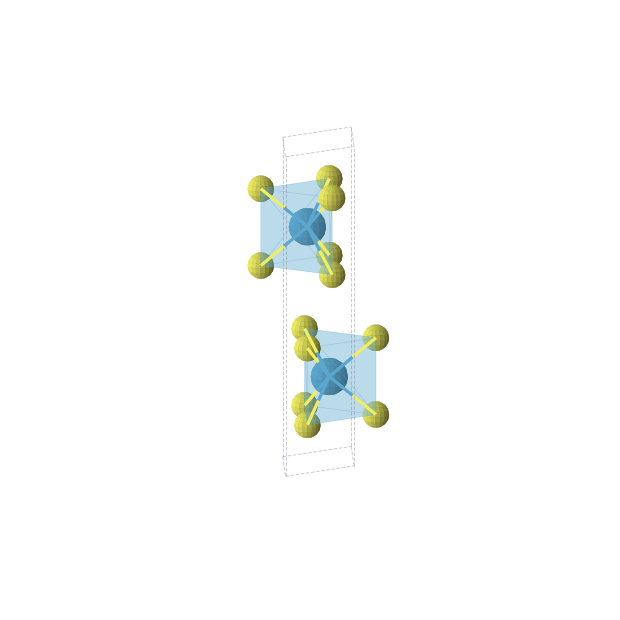
About Tungsten disulfide
Tungsten disulfide is a prominent member of the transition-metal dichalcogenide family, characterized by its reliable semiconducting nature. As a thermodynamically stable material residing on the convex hull, it offers exceptional structural integrity and chemical robustness for high-performance applications. Its layered architecture allows for easy exfoliation, making it a subject of intense research in nanotechnology.
Beyond its structural stability, this compound is widely recognized for its excellent tribological properties. It serves as a high-grade solid lubricant capable of performing under extreme conditions where traditional oils fail. Its unique electronic and mechanical profile continues to drive innovation in fields ranging from optoelectronics to advanced protective coatings.
Key Properties
Cross-validated computational properties for Tungsten disulfide, aggregated across 4 databases.
Band GapEnergy needed to move an electron from the valence band to the conduction band. Lower or zero values tend to behave more metallic; larger gaps are more insulating or semiconducting.
Energy Above HullThermodynamic distance from the most stable set of competing phases. 0 eV/atom is on the convex hull; small positive values may still be experimentally accessible.
StabilityA plain-language summary of the best reported energy-above-hull result. It reflects whether the lowest-energy structure is on, near, or far from the stability hull.
StructuresCount of reported calculated crystal structures for this formula, including alternate polymorphs, source databases, and observed space groups.
Synthesis Routes
Literature-extracted synthesis procedures targeting WS2.
Applications
Where Tungsten disulfide is used.
Patent Landscape
2 patents reference WS2 or close compositional variants.
| Patent | Title | Assignee | Granted |
|---|---|---|---|
| 10183863 | Porous hollow shell WO3/WS2 nanomaterial and method of preparing same | — | — |
| 8303926 | Synthetic methods for generating WS2 nanostructured materials | — | — |
Frequently Asked Questions
Common questions about Tungsten disulfide, answered from cross-validated data.
What is WS2?
Tungsten disulfide is a stable semiconducting transition-metal dichalcogenide widely utilized as a high-performance solid lubricant and a candidate for next-generation electronic devices.
What is WS2 used for?
What is the band gap of WS2?
Is WS2 a metal, semiconductor, or insulator?
Is WS2 thermodynamically stable?
How many polymorphs of WS2 are known?
How is WS2 synthesized?
What elements does WS2 contain?
Where does the data for WS2 come from?
How It Compares
Within the transition-metal dichalcogenides class.
Within the transition-metal dichalcogenide class, WS2 is one of the most extensively studied materials, sharing structural similarities with MoS2. While both materials exhibit comparable layered geometries and semiconducting behaviors, WS2 is often favored for applications requiring superior thermal stability and higher density compared to its molybdenum-based counterparts.
Related Compounds
Other Transition-Metal Dichalcogenides in the database.
Data sources & attribution
- latticegraph — Lattice Graph Materials Intelligence Platform
Analyze WS2 in the Lattice Graph platform
Polymorph comparison, confidence scoring, supply-chain risk, and patent monitoring — across 53 integrated data sources.
Explore the Platform →